
Valley of Flowers: Five Unprepared Men and the Three Who Saved Them
No planning, no training and no hotel rooms two days out — and the three mountain men who kept catching us every time we fell.

Every Bosco Trekking trip starts the same way. Months of planning. A spreadsheet nobody asked for but somebody made anyway. Packing lists with sub-bullets. We are, as a group, insufferable about prep. At this point it isn’t a habit. It’s a personality.
This trip threw all of that off a cliff. No planning. No training. A full-blown hotel catastrophe less than 48 hours before take-off. And yet five middle-aged men still ended up standing in the Valley of Flowers, gear intact, friendship only mildly bruised. Not because of anything we did.
Because of three men in the mountains who kept catching us every time we fell: a guide who fixed the trip with one phone call, a driver who turned out to be ex-Navy, and a trek leader who has climbed with Everest expeditions and still chose to walk at my pace.
This is their story as much as ours.
The Group That Couldn’t Commit
The Bosco Trekking WhatsApp group is alive. Painfully, relentlessly alive, for a group that cannot make one decision without four false starts.
Someone types “where next?” and for exactly one day the chat turns into a war room. Blog links. Google Maps screenshots. Somebody’s cousin’s photos from a trek nobody has heard of. Then the memes roll in, the forwarded videos follow, and the topic sinks without a trace for another month. It happens so regularly it deserves a Wikipedia page.
Andy appointed himself the group’s conscience. Every chai, every other week on the WhatsApp chat, every random Sunday: “Trek ka kya scene hai?“ We’d all nod gravely, agree that yes, we really must finalise something, and then finalise absolutely nothing.
Until mid-June 2026, when Andy stopped asking and started summoning.
“Bhai log, trek ka baat karte hai. Where and when to go?“
No question-mark energy this time. This was a court notice.
I was out for July, at least on paper. Teja said the same. Chendu (Sunil, last year’s recruit, still on probation) had a completely empty calendar and was in for anything, anytime, which is either admirable or mildly worrying.
Jitu (Jiten) said yes almost instantly. Suspiciously instantly. Which told me Andy had already worked on him privately. That’s Andy’s method: he builds a majority one man at a time, then calls a vote he’s already won. Jitu was added to the group the same day. Officially inducted.
Cassay, a fixture on our last two treks, would be out at sea on ship duty. Ships, unfortunately, don’t reschedule for treks.
Final roster: Andy, Teja, Chendu, Jitu, and me.
Destination, Dates, Organiser: Pick Any One
Destination
“Valley of Flowers,” Andy said, in the voice of a man informing us, not asking us.
This was unfinished business. We’d planned this exact trip in 2022 and got shut out completely: landslides took out the path and the government closed the valley before we got anywhere near it. Everyone knew it the second he said it.
Naturally, agreeing immediately would have been far too efficient. So we spent the next while floating alternatives anyway, debating obscure trails recommended by assorted cousins, and eventually arrived, exhausted, exactly where we started. Valley of Flowers.
Dates
This should have been the easy bit. Check when the flowers bloom. Pick a week. Done.
Instead: a month-long negotiation. June. July. August. Nobody wanted to commit first, so everybody kept proposing.
Andy finally drew the line: “We are not pushing this beyond August. The view will be gone by then.” Hard to argue with a flower’s calendar. I threw in “Let’s go 1st week of August,” and in a historic plot twist, everyone agreed almost instantly.
2nd to 9th August. Third attempt. Mission accomplished.
Organiser
This is where we’re actually competent. Years of trekking have given us a solid list of people who get things done. Andy and I split the calls, and Rana ji got back to us. He’d handled our cancelled 2022 attempt, so the trust was already there.
Rana ji, like any good organiser, spotted an upsell. Since we were going that way anyway, why not add Hemkund Sahib, the highest gurudwara in the world, so high it shuts for half the year and the army looks after it? Fair enough. Yes.
Then Andy, never one to leave a good itinerary alone, added Badrinath, one of the Char Dham, sitting a convenient 25 km from our trek’s start point. By now none of us were being consulted. We were being informed.
The plan locked itself in:
- Day 1: Mumbai to Dehradun by flight, then road to Joshimath
- Day 2: Joshimath to Govindghat by road, trek to Ghangaria (base camp for 3 nights)
- Day 3: Valley of Flowers and back
- Day 4: Hemkund Sahib and back
- Day 5: Trek down to Govindghat, drive to Badrinath
- Day 6: Badrinath to Dehradun by road
- Day 7: Stay in Dehradun
- Day 8: Dehradun to Mumbai
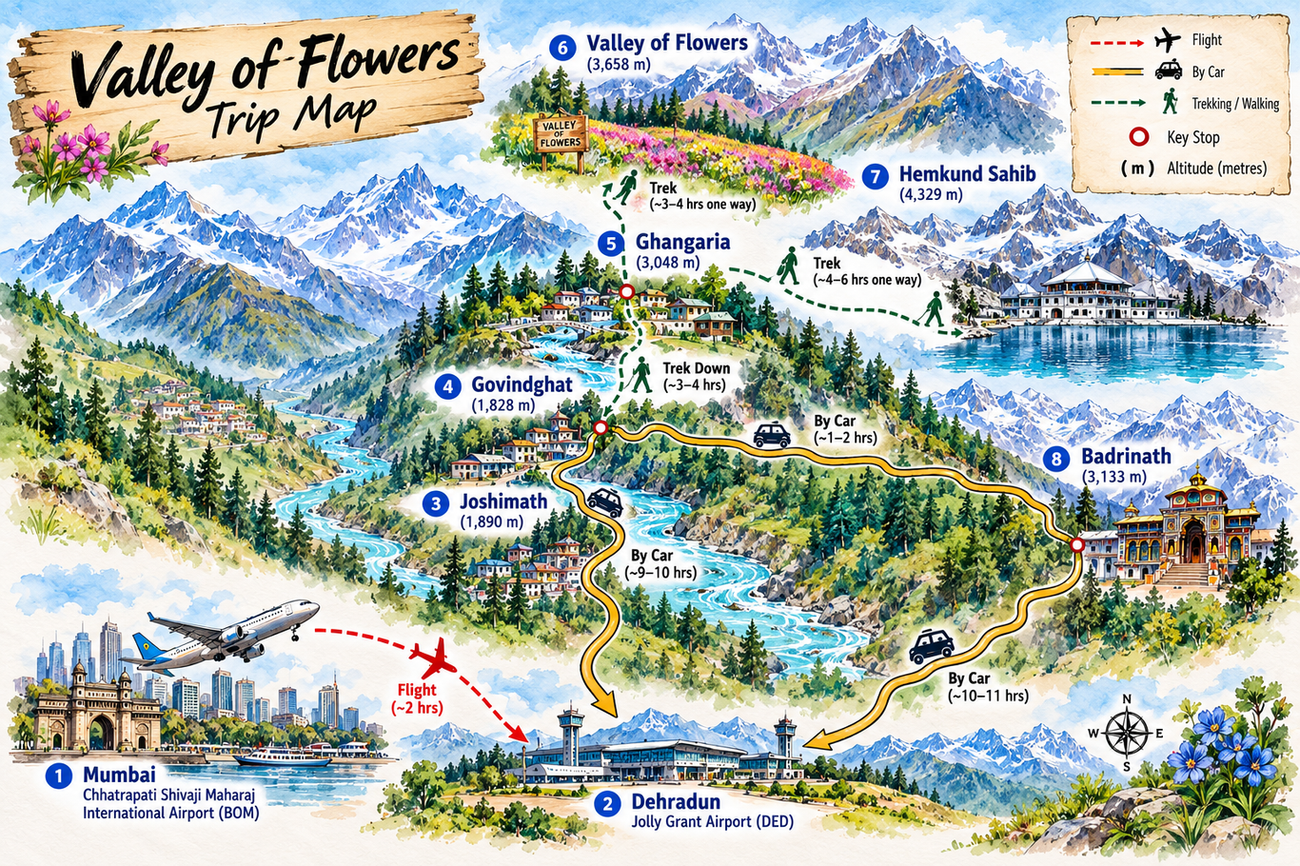
On paper, the most organised trip we’d planned in years.
What could possibly go wrong.
The Prep (A Very Generous Word)
If you’ve read my other trek stories, you know prep is where we overdo it. Gear lists. Practice hikes. The works.
Not this time. Every one of us was quietly drowning in real life, and the trek kept sliding down the priority list without anyone saying it out loud.
- Jitu was buried in his business, discovering that a staff crunch and a Himalayan trek do not politely coexist.
- Chendu, a cricket coach, picked up a new batch of students who ate every spare hour. A cricket coach with no time to train for his own trek. Irony, fully loaded.
- Andy, a paediatrician who spends the monsoon telling every parent to keep their kids healthy, never once took his own advice.
- Teja was juggling his finance business through a genuinely hard stretch at home, with elderly family unwell.
- And I had new clients chaining me to my desk long after I meant to log off.
Training
Some evening walks. A few flights of stairs, climbed with unusual seriousness. Pickleball twice a week.
That was it. That was the entire physical preparation five grown men brought to a Himalayan trip with three days of high-altitude trekking and a gurudwara that closes for snow.
Shopping
Now this we trained for. Real dedication. Two full weekends. Half a month’s salary, gone, on gear most of us use once a year.
Andy pitched me a pair of Columbia trekking shoes with the conviction of a man on commission, and I caved. In my defence, my old pair was falling apart. Jitu and Chendu saw mine, decided they needed the same energy if not the same brand, and came back with their own. Peer pressure, it turns out, does not retire when you do.
Then clothes. Another big chunk of the budget. We skipped Decathlon this time, went out as a group with grand plans to shop together, and within an hour had scattered to different stores without anyone noticing. Silver lining: nobody turned up in matching outfits. We looked like five different people instead of a school picnic.
Medicines
As always, Andy sent the list, I forwarded it to my pharmacy guy, and by evening the kit was at my door. No back-and-forth, no missing Diamox.
Whatever chaos the rest of our planning is made of, this one bit runs like a Swiss watch. Efficiency level: Expert. Enjoy it. It’s the last time you’ll read that sentence in this post.
Two Days to Go. Everything Collapses.
We’d survived indecisive dates, an indecisive destination and training you could fit on a Post-it. We told ourselves the hard part was over.
We were very, very wrong.
Friday, 31st July. Flight on Sunday. Forty-eight hours out, that blissful zone where there’s nothing left to check. And that’s exactly when Rana ji dropped one message into the group.
No hotels. Peak season. Everything overbooked.
Most of us were at work, not glued to our phones the way five men planning a trip probably should be. Jitu saw it first and started pinging everyone like the building was on fire.
Andy called Rana ji, hoping the voice version would be kinder than the text version. It wasn’t.
“Sir, rooms nahi hai. Peak season hai so cant get any. We may have to either cancel or push the dates.“
Neither option existed. Five separate lives, work, family, Teja’s situation at home, were all built around these exact dates. Cancelling wasn’t a plan. It was a different disaster wearing a plan’s clothes.
1pm. I was driving back from the office when Andy called. Within minutes, all five of us were on a joint call, talking over each other like a news-channel panel. We split the work fast. Andy would call Nandu sir, our go-to for emergencies. I’d call Trilok ji, our guide from the Bhrama Tal trek. A man who knows these mountains the way you know your own lane, and who has a cousin, friend or friend-of-a-friend in every town on every route.
It rang a few times. Then, warm as ever:
“Girish ji, kaise ho? Aaj kaise yaad kiya?“
The relief of him just picking up.
“Trilok ji, aap kaise ho? Main ek mushkil mein hoon aur aapki help chahiye.“
“Hukum karo sir. Aapke liye hum hamesha hai.“
No hesitation. None. I explained the whole mess.
“Ho jayega sir. Aap aapka itinerary bhej do, main karta hoon.“
Itinerary sent in seconds. I updated the group. A flood of thumbs-up emojis came back: the WhatsApp equivalent of five men exhaling at once.
Two hours later: “Sir, dates ok hai, itinerary ke hisab se ho jayega.“
I read it twice. Rana ji had just told us, categorically, that there was nothing. Anywhere. So I called back, just to make sure I wasn’t hallucinating hope.
“Trilok ji, pakka hoga na? Pehle organiser ne bola hotels available nahi hai.“
“Pakka sir. Mere dost ka hotel hai. Aapke liye mast deal kar dunga.“
The confidence of a man who has done this before. Given what he’d pulled off on Bhrama Tal, I trusted him completely and, for the first time in hours, actually breathed.
Within the hour came the cost. Lower than Rana ji’s original quote. With the exact car we wanted. Trilok ji then set up a new WhatsApp group with his cousin Vijay ji, who’d run everything on the ground. By evening Vijay ji was collecting our details for permits, sending hotel room photos, and confirming a car big enough for five men and their questionable shopping.
1pm: no rooms, no hope. Late evening: everything sorted, and cheaper.
All because one phone call landed with the right man.
One Day to Go: Reverse Tetris
We’d bought so much gear over those two shopping weekends that I genuinely didn’t know if it would fit in one bag.
Saturday afternoon became a full session of reverse Tetris on my bed. Rucksack open. Everything out. Repacked. Unpacked. One more attempt at squeezing in the sleeping-bag liner without crushing the rain jacket. Vidya walked past twice, looked at the crime scene on the bed, and wisely said nothing. Half a day of negotiating with my own luggage, and the zip finally closed.
This time, Bagwati stayed home. My faithful old daypack, retired for the trip. In her place: a brand-new Tripole I’d bought for my son Devansh, same brand, one size up. There was a very specific reason I picked that one. You’ll find out at the end.
I photographed the packed bags and sent the photo to the group like a trophy. Small win. Felt enormous.


Thankfully, I wasn’t the only one struggling. Everyone else was further behind. Teja hadn’t even started, and announced it with the serenity of a man who has made complete peace with his own chaos.
I found a packing checklist online and forwarded it to everyone, mostly so nobody could later blame the group for forgetting their gloves. By evening, all five were packed.
Trilok ji called. “Sir, sab ready hai?“
“Haan ji, Trilok ji. Humara flight details bhejta hu. Vijay ji ko bol dena time pe pohunch jaye.“
The day vanished so fast I barely sat down with Vidya and Devansh. They didn’t mind. They know this trek is one of the fixtures of my year, and they’d spent the whole day helping me pack, medicines included, without being asked twice.
Before bed, the three of us finally sat together. No packing lists. No group pings. Devansh wanted to know the grand plan for the week.
“Walking,” I said.
We all burst out laughing. Two months of chaos, and the entire plan boiled down to one word.
Then the house went quiet. Except for that particular restlessness the night before a big trip, where you wake up every hour to check the time, as if the flight might leave without you if you blink too long.
Day 1: The Never-Ending Commute
5am
Up on cue. First message to the group.
Andy replied first: “I’m at the hospital, final check on the little ones before we leave.” Andy and his wife Deepa, also a paediatrician, run their own hospital, and he wanted to see the newborns himself before vanishing for eight days. One less thing on Deepa’s plate. Not every trek begins with a man doing rounds on infants at dawn. That’s Andy.
Vidya had been up with me since 5, quietly checking I hadn’t forgotten anything, even though the bags were sealed shut. At 5:45am Devansh appeared from the bedroom, right on schedule. He has some internal alarm that only goes off when I’m leaving for something like this. He has never missed a goodbye.
The 750-metre problem
“I’m leaving,” I typed.
“Come to my building. Driver’s ready,” Andy replied.
Andy lives 750 metres away. Normally a stroll. At 5:45am, with a rucksack the size of a small fridge on my back and a daypack strapped to my front, “normally” doesn’t apply. And of course, not one auto. Not one human. The road looked like the city had been evacuated overnight and nobody had told me.
So I started walking.
A hundred metres in, an auto materialised out of thin air, like it had been waiting backstage for its cue. Three minutes later I was wrestling bags into Andy’s car boot while his driver watched two grown men treat luggage like a contact sport.
Chendu was next on the route. Running late, naturally. We gave him his customary five minutes. Jitu, astonishingly, was already outside his building waiting, and none of us knew how to process that.

Teja lives across Mumbai, so he was making his own way.
Cutting it fine
Thirty-five minutes later we rolled into Mumbai airport. Empty roads, zero traffic. The only thing on this entire trip that went exactly to plan.

No Teja. We walked in anyway, like men who had never heard of waiting for a friend. DigiYatra made entry so fast it felt like cheating. Bags checked in. Still no Teja. Then the call.
“I’m at the airport. Where are you guys?”
“We just checked in. Aaja, we’re waiting for you, late lateef.”
We marched him to our counter and told the officer this was our late arrival, could she please hurry things along. As if Teja, who flies for work more than the rest of us combined, needed help at a check-in counter.
Then the sacred ritual of any decent trip: the complimentary lounge breakfast. Between five men’s credit cards, we had enough plastic to walk in like VIPs.
7:15am. Flight at 8:40am. Loads of time. Famous last words.
Boarding drama
By 8:15am we left for the gate, which turned out to be a bus ride away. No aerobridge. And by now the airport was calling our names. On loop.
The announcer had a genuinely lovely voice. Hearing that lovely voice say your name, followed by the words “holding the flight”, is not lovely at all.
When we finally reached the gate, every passenger looked at us like we’d been caught shoplifting. There were other latecomers behind us, but the announcements had already made us the face of the delay.
Wheels up
We made it. Our seats were in row 3, but the front rows were empty, so we quietly upgraded ourselves.


Phones out, earphones in, downloaded movies ready.
Everyone except Chendu. A single man seated beside an attractive foreign traveller has bigger priorities than cinema. He talked to her for the entire flight. The rest of us watched our films in peace, and somewhere midway Jitu dragged Andy, Teja and me back into our usual nonsense. Chendu remained, understandably, unavailable.
Dehradun
10:30am, Jolly Grant Airport, Dehradun. Proper aerobridge this time, and being up front meant we were first off. The cabin crew sent us off with warm smiles, despite having spent the flight clocking us as the gang who nearly held up the gate.


Vijay ji was already waiting, exactly as promised. While he pulled up, we did what every self-respecting group does: posed with the airport sign like tourists who’d never left Mumbai.
Then Vijay ji rolled up in his Kia Carens, and it was a proper reunion. We hadn’t seen him since Bhrama Tal, two years earlier. Bags strapped to the roof in minutes. Joshimath, here we come.
Joshimath is 8 to 9 hours by road. Yes, that’s a wide range for one drive. Mountain roads don’t care about your Google Maps estimate. Hairpin bends, construction and the ever-present threat of a landslide can turn 8 hours into 10 without warning.
A little way out of the airport, we stopped for tea and to re-tie the bags on the roof carrier. Then back on the road.


Priority one: liquor
When you’re heading somewhere colder than you’re used to, this is obviously the most urgent item on the list. So my first instruction to Vijay ji was clear: stop at the first liquor shop we pass.
Why first and not last, like sensible people? Because you never know if the last shop will have what you want. First shop, guaranteed stock. Strategic thinking. Consultants charge lakhs for insight like this. I gave it for free.
Three hours in, we found one. We stocked up for the valley and, since we were already there, one beer each for the road. Photo session with the loot. Back in the car.


The quiet man with the tattoos
I was in front, and noticed tattoos on Vijay ji’s arm. I asked about them, expecting something ordinary. Instead: he’d served years in the Indian Navy before a family emergency brought him home, which is how he ended up running treks with Trilok ji. The car went silent for a second. Then the nonsense resumed, with a little more respect in it.
Devprayag
Two hours later we reached Devprayag, where the Alaknanda and Bhagirathi meet and officially become the Ganga. You can actually see the difference. The Bhagirathi charges in muddy and furious, straight off the Gangotri glacier. The Alaknanda arrives calmer and deeper from Badrinath. Two very different personalities merging into one river. Basically a marriage.
It’s the last of the Panch Prayag, the five sacred confluences of the Alaknanda, and the point where the gentle foothills hand you over to the serious mountains. Photos taken, we pushed on.

Vijay ji reads the room
An hour later, Vijay ji pulled over. Unprompted. “Sir, beer lena hai?“ He’d noticed round one was long gone.
“Yes!” Jitu shouted, before the rest of us had processed the question.
Andy, Teja and Chendu passed. Two more beers for Jitu and me. The man reads a car better than most managers read a team.


By 5pm it was getting dark and the rain had joined us. The mountains looked stunning even through the drizzle, so of course we kept stopping for photos, which is exactly why mountain drives take 9 hours.
Joshimath, 8pm
Full darkness when we rolled into Hotel Panchvati Inn. Small, solid, and they gave all five of us one room with beds so enormous it didn’t matter.
Dinner meant navigating a maze of corridors nobody could memorise on the first attempt. Simple dal, rice and sabji, just enough for stomachs still full from a day of road snacks.
Then our trek lead, Nilesh Negi, came by to brief us. A career trekker. Leading groups is his full-time job, and he’d done enough expeditions to know exactly what goes wrong, how, and when.
We repacked: one spare foldable bag with everything we wouldn’t need on the trail, left behind in Vijay ji’s car. Only essentials go up the mountain.
Nightcap
Nobody was remotely sleepy, so out came the whiskey we’d saved for exactly this moment. No more flights. No more hotel crises. Just five men on giant beds, finally realising: we’re actually here.
The nonsense slowed into something quieter. Half recap: the near-missed flight, Chendu’s new friend, Vijay ji’s Navy tattoos, watching two rivers become the Ganga. Half anticipation of what was coming. A toast went round to Trilok ji, without whom we’d all be sitting in Mumbai, and to a trip that had come within one WhatsApp message of dying.
A few pegs in, the conversation thinned into that comfortable silence only old friends can manage. The bottle emptied. The bed won.
Day 2: The Actual Trekking Begins
The sleepless night
I did not sleep. Not even a little. Not in any way that counts.
The culprits: a gang of young guys in the next room, wide awake till 4am, doing whatever young guys do in hill-station hotels at that hour, at full volume. Meanwhile Andy, Teja, Jitu and Chendu slept like they were being paid for it. I lay there between the party next door and the snoring on my side, the only sane man in the asylum.
Sleep found me at 4:30. Left again at 6. By 6:30 I hauled myself out of bed like a man escaping quicksand, and was bathed and ready in 30 minutes, running purely on fumes and spite.
The view outside
We stepped outside and the view stopped us mid-yawn. Low, heavy clouds drifted through the valley, half-veiling the forested ridges, and within minutes the whole thing turned into a total whiteout. Mountain weather has more mood swings than our WhatsApp group.
And that called for some photos.


Breakfast
Upma, paratha, chai. The five of us finished first. The other group joining our trek hadn’t even started. Efficiency, thy name is Bosco Trekking. (The preparation, we’ve established, is another matter. Let’s not reopen that wound.)
Packed lunch for the road: pulao.
Blessings first
Vijay ji mentioned the Shri Narsingh Temple, a kilometre away, so Teja, Andy and I walked over for darshan before the trek. Photography isn’t allowed inside, and for once we followed the rules like model citizens.
It’s dedicated to Lord Narasimha, Vishnu’s fourth avatar, and believed to have been established by Adi Shankaracharya in the 8th century. It’s also where Lord Badrinath spends his winters: when Badrinath shuts for the snow, worship moves here. Standing in front of an idol that old, with a long walk ahead, you feel a little smaller and a little steadier at the same time.
Chendu and Jitu turned up as we finished, did theirs, and we grabbed a group photo before heading back.


Haathi Parvat
The other group was still loading their bus, so we had a rare luxury on this trip: spare time. Vijay ji pointed across the parking lot. “Sir, ye Haathi Parvat hai.“
Elephant Mountain, and yes, it genuinely looks like one. Locals say two rock spurs near the top are a crow and an eagle deep in conversation about the universe. At about 6,727 metres, it also quietly put our own ambitions in perspective.


“Sir, ready ho? Chale?“ Nilesh bhai shouted.
“Yes, bhai!” We piled into Vijay ji’s car; the others into their bus.
The 40-minute drive that wasn’t
Trekkers like us don’t just sit in a car and politely get out at the destination. We see a view, we stop. We see the next view, we stop again. A 40-minute drive got three photo stops.
One of them was Vishnuprayag, where the Alaknanda crashes into the Dhauliganga inside a rocky gorge. It’s the first of the Panch Prayag, the same family as Devprayag from yesterday. Legend says Narada meditated here and Vishnu appeared before him. Two peaks, Jai and Vijay, stand guard on either side like bouncers outside Vishnu’s house. Pilgrims once bathed at the confluence. Today that’s strongly discouraged, for one simple reason: the river will take you.


Govindghat, and the jeep shuffle
The trek doesn’t start at Govindghat. Only licensed jeeps run the last 4 km to Pulna, so we moved our bags into one. Vijay ji had a car repair to sort first and promised to catch up, so our spare bags stayed locked in his car.
Meet Nilesh bhai
Nilesh bhai hopped into our jeep, and the proper introductions began. Guiding groups like ours is only part of his job. He also goes on expeditions himself and accompanies professional climbers on extreme ones. Everest included.
This man was now leading five middle-aged Mumbaikars to look at flowers. We felt slightly under-qualified for the company. But the wavelengths matched instantly, and we knew this was going to be a good one.

Pulna: the real starting line
Fifteen minutes up a narrow road beside the river, and the motorable world ended at Pulna. As requested, Nilesh bhai had arranged a mule for our big rucksacks and assigned one of his team to our group of five. A short briefing, and we were off.
Pulna to Ghangaria: 10 km of climbing disguised as a scenic walk
The air changes the second you step on the trail. Pine. Wet earth. Then the sound arrives before the steepness does: the Lakshman Ganga thundering through the gorge below, loud enough that you give up on normal conversation.
The path is stone-paved and shared by trekkers, pilgrims and mule trains. Like a Mumbai local platform, minus the pushing, plus a lot of dung.


It’s monsoon, so the cliffs are alive. Every few hundred metres, another nameless waterfall pours off a rock face and mists your face for free.
Within minutes, the group sorted itself as it always does. Teja, Andy and Jitu shot ahead and vanished. Chendu and I took the scenic route, which is a polite way of saying the slow one. Photos of waterfalls. Photos with waterfalls. Long chats with fellow trekkers.
And then my body sent the bill for last night. Three kilometres in, I was done. Seven to go. Not a number you want to do maths on while gasping.
The kind of leader you remember
Nilesh bhai caught up, took one look at my face, and sent our guide ahead with the others. A professional trek leader, choosing to crawl at the back of the pack.
“Girish sir, aaram se. Koi jaldi nahi hai. Main aapke saath chalunga.“
We’d seen this once before, on Sandakphu, when Chendu got hit by altitude sickness. Some leaders guide you. Others look out for you. Nilesh bhai was the second kind.
Bhyundar village: the halfway haven
Halfway up, the forest opened into Bhyundar. Wooden houses, terraced fields, and locals strolling about at an altitude where we were wheezing. Nilesh bhai sat me down at a dhaba and insisted I eat. Washroom, cold water on the face, Chendu’s tiffin of pulao. Thirty minutes later I felt human again.
The bridge Nilesh bhai picked
About ten minutes after we restarted, the river below us turned louder and wilder. This is the Lakshman Ganga, born at Ghangaria where the Pushpawati, racing down from the Valley of Flowers, meets the Hem Ganga hurtling down from Hemkund. So wild you wouldn’t dare go near it.
Two bridges here. One shiny new steel suspension bridge. One old wooden one. Broken, but “strong enough,” Nilesh bhai assured us. Naturally, he recommended the broken one.
I chose to focus very hard on the words “strong enough.”
Standing on it, with an icy blast coming straight off the glaciers and the river roaring below, we had our first proper pinch-me moment.
Then the trail changed personality
If Pulna to Bhyundar was a pleasant stroll, the last 4 to 5 km to Ghangaria was the entrance exam. The path tilted sharply upward into dense forest of deodar, oak and rhododendron. Stone switchbacks, slick with moss and dew, where every foot placement needed a decision.
Past 2,500 metres, the oxygen starts rationing itself. My heart rate shot up and I settled into what I’d call the Himalayan shuffle: short, slow, agonising steps, breathing matched to stride. Looking back through the trees, Bhyundar was now a toy village in a green bowl.
We even spotted honey bee nests high up on the cliffs. There were so many that we could hear the buzzing from the trail, even though the nests were far above us.

From here, the last two kilometres are notorious. Every bend promises the village. Every bend delivers another staircase into the mist. When mules and porters come up behind you, you flatten yourself against the mountain to let them pass, which, I’m happy to report, doubles as a 30-second break for screaming thighs.
Just when you consider dropping your bag and quitting, a wooden shack appears selling lemon water and hot Maggi. You don’t stop for the Maggi. You stop to swap exhausted, sweaty, weirdly determined looks with total strangers.
Ghangaria
And then, like a film cut, it’s over. The incline eases. The forest parts. A huge meadow ringed by rock walls vanishing into cloud. The air turns freezing and dries the sweat off your forehead. Ahead, tin roofs and colourful flags float out of the fog. Ghangaria, 3,050 metres.
Legs shaking, shoulders aching, we walked the last flat steps in, and every bit of the last few hours suddenly felt worth it.


Mountain rain does not negotiate
And just as we almost arrived, the rain arrived too. A drizzle. Harmless, I thought. Mumbai-man logic.
These are not Mumbai rains. Nilesh bhai spotted me ignoring it and shouted: “Sir, poncho pehen lo. Nahi toh beemar pad jaoge.“
I obeyed like a good student. After getting thoroughly soaked first, obviously.
We finally reached our stay for the next three days, Hotel Shyam Palace, a cosy place at the far end of the village. Jitu was already on a massage machine, working on his foot.


The bath ritual
Andy, Teja and Jitu had already settled in. Jitu and I shared one room, the other three the next. Teja briefed me on how bathing works up here:
- Hot water is pay-per-use: Rs. 100 for 30 minutes.
- The geyser takes 10 minutes to warm up, because it’s cold and it knows it.
- No shower. Bucket only.
- Do not wait for the bucket to fill before you start. The cold will turn your hot water lukewarm while you stand there admiring it.
After the day I’d had, that was far too much information. I told him to get the guy to switch on the geyser and that I’d figure out the rest. A warm bucket bath at 3,000 metres turned out to be one of the great luxuries of my life.
The bill arrives
It was below 10 degrees and dropping. Somewhere between the bath and dinner, I started feeling off. Slightly feverish. Heavy. That warm, weak feeling that turns up uninvited.
I knew exactly who to blame. Me. Nilesh bhai’s “beemar pad jaoge“ replayed in my head with perfect comic timing. Decades of Mumbai monsoons had taught me nothing, and the mountain had needed exactly one afternoon to prove it.
It wasn’t strong, so I kept quiet. Dinner at 8. Bed by 10.
Tomorrow: the valley we’d waited four years for.
Day 3: The Valley of Flowers
Four years in the making
Today was the day. In 2022 we’d planned this exact trip and cancelled a day before, thanks to a landslide. Four years of “next time” and “this year, pakka.” Four years of scrolling past other people’s Valley of Flowers photos with the quiet bitterness of a man who did all the planning and got nothing for it.
Not today.
The fever? Gone.
We were awake by 6 but nowhere near leaving our blankets. Below 10 degrees, in August. Mumbai can only dream of that.
And the fever had vanished overnight. After yesterday’s lesson, I took it as a small miracle.
Jitu had done a surprisingly respectable job of not stealing the blanket. By 6:30 we wandered into the other room, found Andy, Teja and Chendu still in bed, and did what grown men do when they see friends in a cosy bed: we climbed in. The chatter started all over again, until the other group woke up and drowned us out. Gen Z. Their volume knob has one setting.
Nilesh bhai, 7am
He walked in looking fresh enough to start the trek that second. “Uth jao sir. 8 baje nikalna hai.“ Delivered with the permanent smile of a man who has never once been tired in his life.
Breakfast down, and then a packed lunch we had zero interest in carrying. Nilesh bhai insisted we’d need the energy. Arguing with a man who’s been up since dawn and looks like a toothpaste ad is a losing battle. Into the bag it went.
The check-post, and the plastic audit
8am sharp. Andy, Teja and Jitu ahead, Chendu and I behind. As always. Vijay ji, who had made it up to Ghangaria after sorting out his car and checked into another hotel in the village, came along for the valley too.
Nilesh bhai’s team had already reached the forest check-post with our names, so we walked straight through. Until this point the valley is completely hidden, so crossing the gate feels like walking on stage before the curtain goes up.
Then the best rule in the Himalayas. Forest officials count every piece of plastic in your bag on the way in, and you must bring back the exact same count. Wrappers. Bottles. All of it. Our plastic was counted in and counted out like prisoners. Easily the most disciplined thing we did all trip.


Into the gorge
The trail drops into a shaded gorge and the Pushpawati takes over the soundtrack. We crossed an iron suspension bridge over milky-white glacial water, with Gauri Parvat and Nilgiri Parbat, both above 6,000 metres, glaring down at us. Monsoon waterfalls were pouring off every rock wall. Gorgeous, and slightly terrifying.

From here: about 3 to 3.5 km of climbing to the mouth of the valley.
The first kilometre: the trail stops being friendly
A steep zigzag up the mountain’s flank. Uneven stone steps, loose gravel, tree roots, everything slick with moisture. Birch and rhododendron forest, moss on every surface. The river’s roar slowly softened into a rumble below us.
Halfway through, the mountain decided the climb needed more drama, and a light rain began. On wet stone, “light” is relative. This time I heard Nilesh bhai’s “beemar pad jaoge“ in my head before I got soaked. Growth.
Glacial streams and the poncho incident
After the first kilometre, ice-cold streams started cutting right across the path. Stepping stones, fast water, zero room for carelessness. Then a couple of stretches of loose scree, where the advice is to keep moving and never stop, since the slopes like dropping stones in the rain. I crossed those like a man late for a meeting.
And then Teja came down past us.
He’d already reached the valley, explored it, gone deep inside, and was on his way back while we were still climbing. Faster than most of the trek guides. He stopped for exactly one thing: the room keys in my daypack. He yanked up my poncho to get at them, the poncho tore, and he was gone.
So there we were. Still climbing. With a wounded poncho.


The Blue Poppy viewpoint
At about 2 km from the bridge, the trail levelled out at a rocky ledge. Looking back: a bird’s-eye view of the gorge and the tiny thread of river we’d crossed. A useful reminder that we had, in fact, climbed all of that.
The trees disappeared. Shoulder-high pink Himalayan balsam took over. And there, growing out of damp rock, we spotted it: the Himalayan Blue Poppy. Rare, famous, and absolutely worth the wheezing.

Andy and Jitu passed us here too, also on their way back. Nothing lifts morale quite like your friends heading home while you’re still going up.
The arrival
We cleared the final bend, the vertical world flipped horizontal, and we were in the Valley of Flowers.
A huge U-shaped glacial valley, about 8 km long and 2 km wide, carved by ice over thousands of years, ringed by snow peaks. This is where the valley shouts at you: you have officially arrived.
Four years of waiting. And to its enormous credit, the Valley did not disappoint.
The colours
There is no single colour here. It’s a living watercolour. Acres of pink and purple balsam swaying in the wind. Patches of yellow marigolds, like someone spilled sunshine on the grass. Down low, white anemones, blue forget-me-nots, wild strawberries and deep blue gentians.
Rataban, Gauri Parvat and Nilgiri Parbat stand guard overhead. Thin silver waterfalls slide down near-vertical cliffs and vanish into mist. Through the middle, the Pushpawati splits into braided streams over grey gravel.
The weather had mood swings. Bright sun one moment, turning petals translucent. A wall of white fog the next, swallowing the peaks whole and making the whole place look like a dream sequence.
Peaceful solitude, however, was not on the menu. The valley was packed. Trekkers from everywhere, sharing the same view, the same photo spots and the same collective “wowww.”


Pictures. Pictures. More pictures.
We did what everyone does. Pictures of the valley. Pictures with strangers. And, I suspect, pictures of strangers taking pictures of us.
We never stopped for lunch. That packed lunch Nilesh bhai insisted on spent the entire day riding in our bags. A very expensive form of strength training.


The 5pm curfew
At 2pm we wanted to go deeper. Our guide said no. Everyone must be out of the valley by 5pm, the walk back takes 2 to 3 hours, and rangers start sweeping the meadows from about 1:30 to nudge people home. No overnight stays. Ever.
The most beautiful place we’d ever been had a stricter curfew than a boarding school.
What the speedsters saw
Teja, Andy and Jitu had gone as far as the river at the heart of the valley, and they told us what we’d missed.
About 3 km in is the simple stone memorial of Margaret Legge, a British botanist who slipped and died here in 1939 while collecting flowers. She came for the flowers and never left. Her epitaph reads: “I will lift up mine eyes unto the hills, from whence cometh my help.”
Beyond that, the flowers give way to boulders and ice near the Tipra Glacier, where the botanical valley ends. A reason, if we needed one, to come back.


The way down: easier on the lungs, brutal on the knees
Mist rolled in after 1pm, swallowing the meadow and dropping the temperature. Then 3 km of the same stone steps we’d climbed that morning, now downhill, wet, and personally offended by our knees. The little streams we’d hopped over in the morning had swollen with the day’s rain and snowmelt, so every crossing took twice the care.
Reaching the iron bridge felt like a psychological finish line.
It wasn’t. The mountain had saved one final joke: a half-kilometre uphill climb back to the check-post. After hours of descent, that last little push is a genuine sting in the tail. Plastic audit: passed. Every wrapper accounted for.
Back in Ghangaria
5pm. The village smelled of ginger tea, Maggi and dinner being made somewhere. Damp gear off, boots unlaced, legs complaining. We joined Andy, Teja and Jitu in what had become a full-blown stretching club.
Then Nilesh bhai sat with us in the hotel’s reception-cum-restaurant and told stories from his career. The kind that make you want to drop your whole daily routine and move to the mountains. They teach you how to survive and, more importantly, how to live.
Chowmein, honey chilli potato, gulab jamun
Five restless men cannot sit in one place for long. Chendu mentioned the restaurant next door served great Chowmein and Honey Chilli Potato. Being a foodie, I was inside within minutes. Chendu had already befriended the cook and told him to make it exactly like yesterday. Andy joined soon after.
Food hits differently in the mountains. The Chowmein arrived smoky, garlicky and unapologetically heavy on the soy. The Honey Chilli Potato was sweet, spicy and gone almost as soon as it landed. A steel plate, hot food, clouds drifting past the window. Five-star dining, no reservation needed.


Right across the lane: hot gulab jamuns with thick, steaming milk. Our taste buds dragged us in. After a cold, rainy day at altitude, that combination is the holy grail of mountain desserts.
An hour later Nilesh bhai called us for dinner. Nobody was hungry. We ate a little rice and dal anyway, purely as a survival strategy, and were in bed by 10.

Round two
In bed, I felt the fever creeping back. Too tired to care, I was asleep instantly.
Jitu came in later, saw me shivering, woke me up, and produced medicine from his personal stash, the one he carries on every holiday and every trek. The rain, it turned out, had been saving its revenge for later. And the most efficient medical department on this trip was not the paediatrician. It was Jitu’s backpack.
Tomorrow: Hemkund Sahib.
Day 4: Hemkund Sahib (Reviewed From Bed)
The plan
Andy and Teja would leave at dawn to beat the crowds and the afternoon weather. Jitu had announced the day before that he was skipping Hemkund and staying in. After last night, I said I’d leave a bit later, maybe on a mule. Chendu would come with me.
That was the plan.
5am
Teja had half his stuff in our room, so at 5am he came knocking and got ready with all the subtlety of a marching band. Jitu and I lay there, pretending to sleep. At 5:45 Andy came to collect Teja and check on me.
I was not in a state to leave. My stomach had joined the rebellion.
They left at 6. The rest of us went back to sleep. Or, in my case, began what I can only describe as the Great Washroom Expedition. Ascent. Descent. Ascent. Descent. Every few minutes. The most altitude-neutral trek of my life.
9am. Plan cancelled.
Chendu checked in at 8:30. “Give me 30 minutes,” I said, with the confidence of a man who had no idea. By 9 I told him to go without me. He stayed back. That’s what friends are for.
Then the photos started arriving. Teja, at Hemkund Sahib. Already. Thirty minutes later, Andy, at the top too. Photo after photo after photo, while I lay under a blanket, examining the ceiling.
That’s when I finally confessed. Andy had probably diagnosed it at 5:45 just by looking at me, which is why he hadn’t forced me out of bed. Pro doctor, you see.
Hemkund Sahib, as reported by WhatsApp
Here’s the trek I didn’t do, according to the two men who did.
It’s 6 km from Ghangaria with about 1,100 metres of climbing. In one morning. The trail starts gently through forest, then breaks above the tree line into relentless stone switchbacks with no flat bit anywhere to save your legs. Past 4 km, the air thins enough that ten steps in a row feels like an achievement. The Brahmakamal, the sacred Himalayan lotus, clings to the cliffs up there.
Near the top, you choose: a winding paved path that’s kind to your knees, or roughly 1,100 stone steps straight up the mountain face. Andy and Teja, naturally, chose the steps. They say the sound of Gurbani drifting down from the shrine is what gets you through the last stretch.
Then it flattens out onto a plateau. An emerald glacial lake, ringed by seven snow peaks, each flying a Nishan Sahib. The star-shaped gurudwara beside it, built with roofs steep enough that snow slides off instead of crushing it.
Pilgrims take a holy dip in the lake. Andy and Teja found the courage to step in, and the good sense not to stay. Then hot sweet chai and khichdi at the gurudwara langar, which every trekker who’s been calls one of the best meals in the Himalayas.


The story behind it, in short. Guru Gobind Singh Ji wrote of meditating in a past life beside a lake flanked by seven peaks. The place faded from memory for centuries, until Sikh scholars and pilgrims matched that description to this lake, and Sant Sohan Singh visited the site in the 1930s. At about 4,570 metres, it’s closed to pilgrims through the winter, when snow buries the path and the gurudwara. Every spring an Indian Army team climbs up to clear the route before the yatra reopens in late May. Remember the army from the planning section? That’s them.
I’ll see it next time. With my own eyes. Out of a bed.
Meanwhile, back at base camp
Once my stomach agreed to a ceasefire, Chendu, Jitu and I went next door for breakfast. I had tea and two biscuits. Chendu and Jitu had paratha and tea, while I watched like a dog outside a sweet shop.

Then we went sightseeing and shopping for the family. This is non-negotiable. It guarantees your safe re-entry into the house. The married readers understand.


The most expensive shave in Ghangaria
By 11:30 we had nothing to do, so we sat around talking about school, which turned into a video call with our old school WhatsApp group. Almost everyone joined, thrilled to see us in the mountains.
Then, still bored, Jitu spotted a barber and decided he needed a shave. We forgot to ask the price first. Rs. 200. For a basic shave that costs under 100 in Mumbai. Possibly the most expensive shave of Jitu’s life. To be fair to the barber, every blade and every drop of foam up there arrives on someone’s back.


The lunch standoff
At 12:30 we decided, nobly, to wait for our two Hemkund heroes before eating. By 1pm there was no sign of them. Loyalty has limits. Ours expired at 1pm.
We’d spotted a promising tandoori roti place earlier. The man had vanished. So, back next door for bhurji pav and fried rice.


As we finished, Andy and Teja walked down the mountain. They sat down, looked at our plates, and ordered exactly the same. The universal law of friends and food. Vijay ji had done Hemkund Sahib that morning too, but he never came back to Ghangaria. He carried on straight down to Govindghat, to be ready with the car for tomorrow.
The afternoon of doing absolutely nothing
We sat in the reception and talked. School days. What’s going on in life. How badly life is treating everyone, except for these treks. Chiku video-called our smaller school group, the one fifteen of us call the Elite Group. Nilesh bhai came back from his own trek and joined in with more stories.
Then it rained. And you don’t go out in mountain rain. Not after what it had already done to me.
I did make one trip out: to the shop opposite, to replace the poncho Teja had assassinated, with a one-time-use one for tomorrow.
Medically supervised drinking
Then Jitu stood up and produced the whiskey. Every man in the room instantly located a glass. Nobody in this group has ever been slow to find a glass.
Given the fever and the stomach, I consulted the doctor in the room. Andy approved one small peg. Medically supervised drinking, if you will.
Time vanished, as it does, until Nilesh bhai called us for dinner. Roti, rice, dal, sabji. Then packing for the descent. Start at 6am, down by 9am. That was the plan.
You already know how plans go on this trip.
Day 5: Down the Mountain, Up to Badrinath
Up early. Mule late.
5am, fever gone, everyone bathed and ready. By 5:45 all five of us stood at reception, rucksacks waiting for the mule, daypacks on, like schoolboys waiting for the bus.
6:00. No mule.
6:15. No mule.
6:30. Still no mule.
Nilesh bhai watched us standing there for a good while, then told us to just start walking. He’d personally make sure our bags got loaded and sent down. We said goodbye to Ghangaria, took the obligatory photos, and strolled out of the village.


Rain, ponchos and Bollywood
Within minutes, it rained. Within seconds, ponchos on. Three days in, the mountain had finally beaten some discipline into us.


I connected Andy’s Bluetooth speaker to my Bollywood playlist, everything from the 1950s to last year. Andy, Teja and Jitu sped off as usual. Chendu and I walked slow, as usual, and the songs set our pace. Other trekkers started slowing down to walk with the music. For a while, we were the Pied Pipers of the Himalayas, with a speaker instead of a flute.
We took all the photos we’d been too breathless to take on the way up.


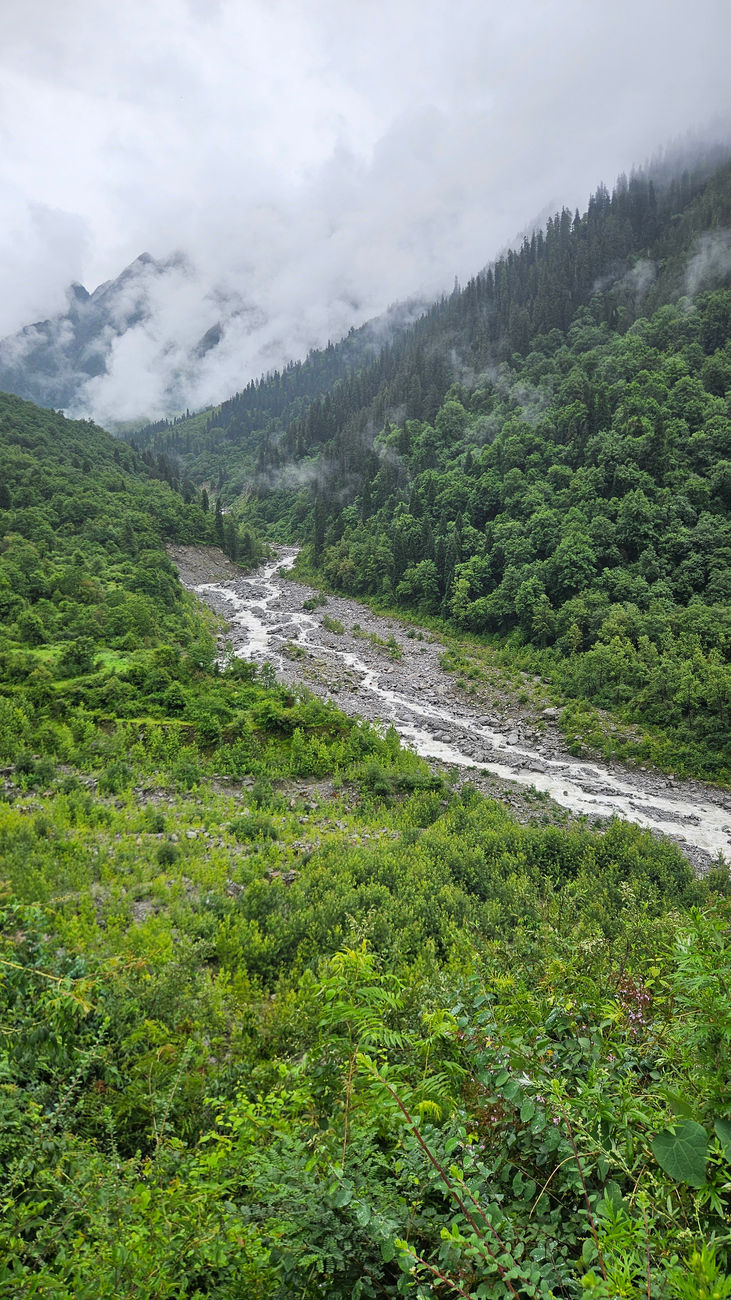

The knee sends an invoice
I always say: if you think the ascent is tough, the descent is tougher. My right knee agreed loudly.
I’d injured it playing pickleball two months earlier, and done physio to get trek-ready. Pickleball: my entire training programme, and also the reason I was limping. The unprepared trek, in one knee.
Chendu didn’t leave me. He walked at my pace, the whole way down.
The new bridge, and the thandai man
Back at the bridge, we took the shiny new one this time. Nilesh bhai wasn’t there to recommend the broken one.

On the other side sat a man in an orange turban behind steel plates piled with almonds, seeds and spices, grinding something creamy in a wide bowl. Fresh thandai, made at a pop-up counter on a mountain trail. Easily the most elaborate roadside stall of the whole trek. I filmed him and moved on.
Then I remembered my physiotherapist, Dr. Tejas Sonar, had shown me how to realign my knee if it acted up. I did exactly that. The pain went away. Dr. Sonar, if you’re reading this: you’re a magician.
The last goodbye
Two kilometres on, Nilesh bhai caught up with the mules and our bags, walked with us for a while, then went ahead to make sure everything was safe at Pulna.


At 9:30 Andy called: the speedsters were already waiting. Chendu and I limped in 30 minutes later. So much for “down by 9.”
Nilesh bhai was standing there with our bags unloaded and a taxi already booked. We said our goodbyes to the man who has guided Everest climbers and still spent his day walking at my slowest pace.
He stayed back to wait for the other group. We were off to Govindghat.


Vijay ji, again
Fifteen minutes later, Govindghat, and there was Vijay ji with his car, ready. He’d joined us at Ghangaria, done the Valley and Hemkund himself, and come down the day before, so he’d had a full day’s rest while we were limping down a mountain. Smart man.
Quick hellos, cab driver paid, and off to Badrinath.
Govindghat to Badrinath: 25 km that feel like 250
On the map, a short hop. In reality, one of the most dramatic stretches of the Char Dham route. The valley closes in, the road goes straight up, and the Alaknanda turns into white water far below the cliffs. Giant rock overhangs form a roof over the car.
And yes, it rained. Of course it rained.
We passed Pandukeshwar, a calm, historic village. Then Lambagar, which is the opposite of calm: one of the most notorious landslide zones on the route. The road turned to mud and loose gravel. Vijay ji kept a steady pace and didn’t stop for anything. The rest of us stared silently at the hillside above, watching for anything that might come down.
Then the tree line thinned, the hairpins tightened, mountain buses came round blind corners, and finally the colourful arched gate of Badrinath appeared. The gorge opened into a wide bowl, with the snow-dusted Nar and Narayan peaks standing guard.
Vijay ji, the hotelier
Our hotel for the night? Vijay ji’s. Started recently with a friend.
This man’s list of achievements simply does not end. Indian Navy veteran. Travel agent. Driver. Now hotelier. At this point I won’t be surprised if he also turns out to forecast the Himalayan weather.
The hotel was so new a few things weren’t finished. We were its very first guests, with the whole place to choose from. Jitu, Teja and I took the big room. Jitu claimed the single bed, uncontested, which left Teja and me to negotiate a blanket treaty on the king. Andy and Chendu took the other.
The doctor is down. Lunch is not.
The moment we arrived, Andy wasn’t feeling well and went straight to sleep. We gave him time.
At 12:30 he woke up. His very first words: “What’s for lunch?”
The group’s doctor was now the patient, and his priorities were in perfect order.
Hotel Kuber Palace, a few metres away: dal, roti, rice, sabji, eaten like we’d been starved for a week. By the time we stood up, it was 3pm.
Badrinath
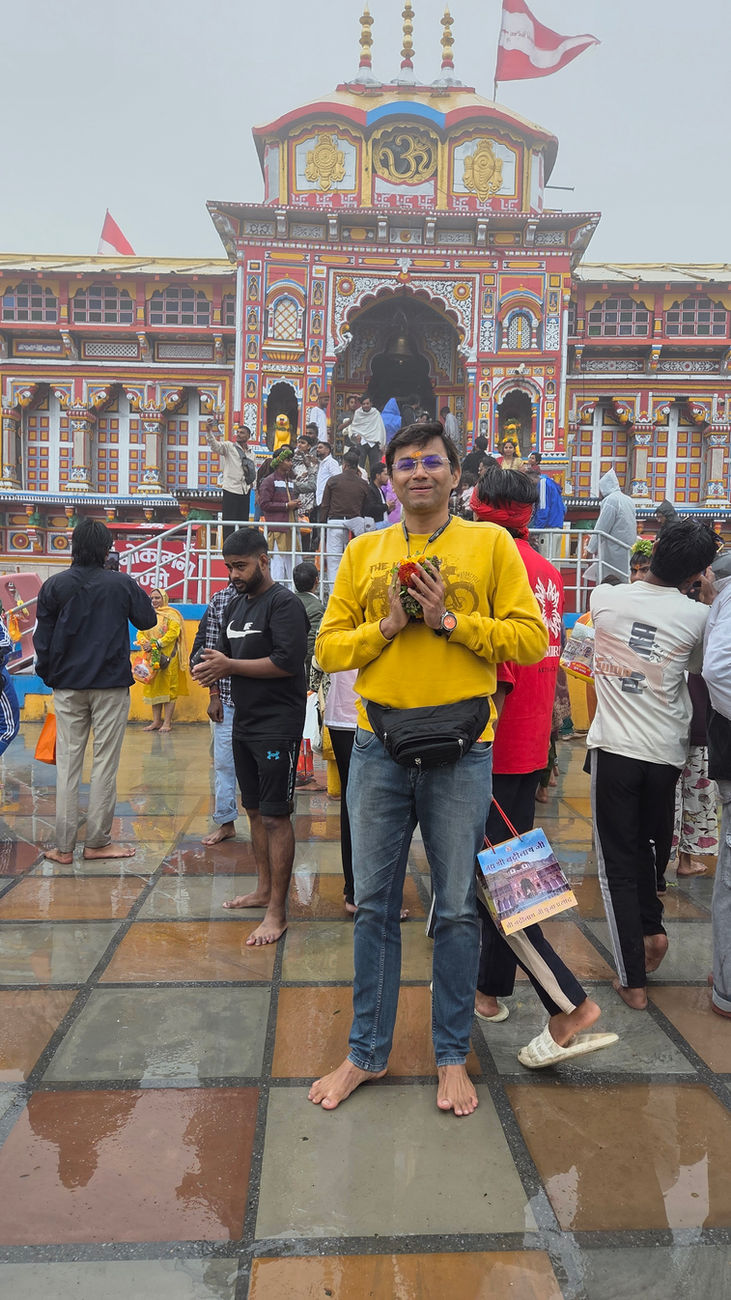
Teja, Jitu and I strolled down a narrow market lane that smelled of mountain cold, camphor and fresh pedas, past stalls of brass thalis and marigold garlands. Then the Alaknanda, icy blue and roaring right beneath a footbridge, and across it the temple’s brightly painted face, glowing like a jewel against the grey mountains. Andy and Chendu caught up on the bridge, and we went in together.


It wasn’t crowded. Darshan in 10 minutes flat.
The idol of Lord Badrinarayan is unlike most images of Vishnu. Not reclining on Sheshnag, but seated upright in padmasana, deep in meditation. About a metre tall, carved from a single black Shaligram stone. Legend says it was hidden from invaders and lost for centuries, until Adi Shankaracharya dived into the freezing Alaknanda in the 8th century and brought it back.
We sat in the temple courtyard for a while afterwards, quietly. Then photos, obviously, and back to the hotel.


Mana: the first village of India
It was 4:30pm, and there wasn’t much to do for the rest of the day. Andy, who had apparently not had enough of the Himalayas, had heard that the first village of India lay near Badrinath: Mana. So we decided to visit. In about 10 minutes by road, we were at the entry point.
Mana sits at about 3,200 metres, roughly 5 km from Badrinath, on the banks of the Saraswati. For years it was sold as India’s last village. In 2022 the Prime Minister said every border village should be called a first village instead, and a “first village” board went up at its entrance the next year. Same village, better branding, and honestly a better way to look at it.
We stood near the edge of the roaring Saraswati, and our eyes were pulled to the opposite bank. Clinging to the steep, rugged slope across the water was a heavily fortified outpost of the Indian Army and the ITBP. It’s one thing to read “border village” on a map. It’s another to look across a river at the people who actually guard it. We soaked it in for a while before heading back to the hotel.


Operation Whiskey, Phase 2
7pm. Jitu produced the bottle we’d left in the car for safekeeping. Chendu ran out for chakna. The rest of us collected glasses.
Yesterday it was one small medically supervised peg. Tonight, the doctor was also drinking, so supervision was officially suspended. Andy, sick at lunch, was well on the road to recovery. He knew exactly what medicine he needed.
Chendu took so long with the chakna that we started without him. He returned like a soldier home from war, with chips and peanuts slung over both shoulders.
Cheers. And off we went.
Three pegs in, we video-called the Elite Group, and this time everyone joined: Chiku, Adu, Savin, Ryan and the rest. They wanted trek stories. We talked about everything except the trek. After 20 minutes the call ended. So did the whiskey.
Mandatory shopping
Dinner at 8, dal tadka and roti. Then shopping, which, as established, decides whether you’re allowed back into your own house. Clothes, mostly. Ironic, considering we’d spent half a month’s salary on trek clothes a week earlier. Several confirmation calls went home to make sure we weren’t buying anything the wives didn’t want.
In bed almost instantly. Tomorrow: the long drive.
Day 6: 325 km, One Lost iPhone, Zero Sleep
No bath, no staff
Up at 5. We collectively agreed to skip the bath. Ten hours in a car awaited; the Dehradun shower could do the honours.
By 6, bags were out. The hotel staff, however, were in deep sleep. I called Vijay ji. He appeared almost instantly. I’m now fairly convinced the man has superpowers: you think of him, he’s there. The two of us spent half an hour in the basement playing car-roof Tetris, wrapping everything in plastic against the inevitable rain. We left at 7.
Neelkanth, for about ten seconds
Just as we pulled out, Andy spotted it between the clouds: Neelkanth Parvat, the snow pyramid rising behind the Badrinath temple. Vijay ji stopped instantly. Our phones couldn’t capture it. Our eyes could.

It’s 6,596 metres tall and nicknamed the Queen of Garhwal. Though Badrinath belongs to Vishnu, this peak belongs to Shiva: Neelkanth, the blue-throated one, who swallowed the cosmic poison during the churning of the ocean. Legend says a footpath once ran straight from Badrinath to Kedarnath, until an angry Shiva raised this mountain to block it forever. Climbers know it as brutal: it resisted seven attempts before it was finally summited in 1974.
At sunrise, they say, its snow turns gold. We got clouds. As a Shiva bhakt, even a ten-second glimpse felt like a blessing to start the day.
The seating plan
Teja up front. Jitu, Andy and Chendu in the middle. Me in the last row, guarding the bags, which slid towards me at every hairpin like they wanted a hug.
Down through the Prayags
Badrinath to Dehradun is about 325 km. It’s not a drive, it’s a geography lesson in reverse. Back through Lambagar, Govindghat, Vishnuprayag and Joshimath. Then the confluences, one after another: Nandaprayag, Karnaprayag where the Pindar joins, Rudraprayag where the Mandakini rushes in from Kedarnath. The Alaknanda getting wider and louder with every one, like a river collecting friends on the way to a party.
Then Srinagar, the Garhwal one, not Kashmir, and finally Devprayag again, where the Ganga is born. Past the rafting camps of Shivpuri, the mountains began to let us go.
Lunch at Vijay Ji’s Friend’s Place
We stopped for lunch at a friend of Vijay ji’s. It was a simple hotel with about 10 rooms and a kitchen set up outside. The menu was mutton, chapati and steamed rice, a special request from our Good Doctor, Andy. He had prescribed it himself.

The food was just okay, but it kept our tummies happy after so many days of vegetarian food. About 1.5 hours later, we were back on the road.
That mutton and rice was enough to make Teja sleepy in the noisy car.

“Mera phone?”
We were nearly there. One last tea break. Everyone back in the car. And then Vijay ji, frozen at the wheel:
“Mera phone?“
His iPhone. Gone. Five men searched the car. Seats, floor, bags, pockets. He kept dialling it from his other phone. Nothing.
Then he remembered. The dhaba. Twenty-five kilometres back. He’d put it on the counter while paying.
It was 5:30pm. Driving back into the mountains at that hour is a problem: night driving isn’t allowed, the police stop you, and it was getting dark fast.
But this was a man who’d spent a good chunk of his savings on that phone. And a man who’d spent four days rescuing us. There was no discussion. We turned around.
Vijay ji, very tense, now drove at 60 to 70 km/h on mountain roads. My last-row seat turned into an amusement-park ride I hadn’t paid for. And yes, the police stopped us. Vijay ji talked them round. We kept going.
An hour and a half later, the dhaba. Chendu was out of the car before it fully stopped. He walked up to the owner like a CID officer arriving at a crime scene and demanded to know about the missing phone.
The owner, slightly alarmed, opened a drawer. He’d found it on the counter and kept it safe.
Five men exhaled. Vijay ji lit a cigarette and took a few long, grateful puffs. And we turned around, again, towards Dehradun. It was 7pm and fully dark.
I asked Vijay ji, politely, to drive slower now. The last row had seen enough.
Through the forest, into the night
Past Rishikesh, the mountains were officially over. The air turned warm, the road flattened, and the highway cut through the Rajaji National Park forest. Pitch black, but we watched for wild elephants anyway. None came. Probably asleep. Sensible creatures.
The theka
First stop in Dehradun: the theka, as wine shops are called up north. Two bottles of whiskey for the days ahead, plus beers for the last leg, to celebrate Vijay ji’s phone coming home.
Unprepared, one more time
We reached Clarks Inn Express at 9:30pm, two and a half hours late. Andy had booked it from the car, at the last minute, without negotiating. Of course he had.
Teja, our finance man, stepped in and got us a discount. Andy, Chendu and I took one room; our two businessmen, Teja and Jitu, took the other.
3am, and nobody is sleepy
Baths first, one at a time. By 10:30 we were all clean, exhausted and absolutely not going to bed. Our room had an extra bed squeezed in, so the party moved to the businessmen’s room. Chendu’s leftover chakna came out, ran out, and I called in reinforcements via Zomato.
The first bottle was opened while I was still ordering. After ten hours in the last row, I had no interest in a chair. I took the floor. Everyone else joined me down there.
The drinking didn’t stop. Nor the laughing, the singing or the senseless talking. Five forty-something fathers, husbands and professionals who spend every day being responsible. Behind a closed hotel door in a sleeping Dehradun, that simply wasn’t an option.
Then the dancing started. In socks. On a hotel carpet. In a room never designed for five grown men performing the moves from their school farewell. Someone remembered an old step. Someone else insisted it never existed. The debate was settled by everyone performing it at once. Whoever was next door was almost certainly drafting a complaint to reception.
Then the school stories. Teachers’ nicknames. Who copied whose homework. Who got caught first. Whose mother found out first. Retold with more detail and more drama each time, as if hearing them for the first time. That’s the thing about old friends: none of us has ever actually grown up in front of the others, so nobody has to start now.
We nearly video-called Cassay on his ship to show him what he was missing. We decided against it, mainly because he’d be asleep and would wake up to five men who couldn’t stand straight.
At 4am, our bodies finally filed a formal complaint. We fell into bed and were asleep before our heads landed. Tomorrow had exactly one item on the agenda: nothing.
Day 7: Nothing to Do. What to Do?
9am. A crime.
I woke at 9. For most people, that’s a blessing. For a morning person like me, it’s a minor crime. But the plan was nothing, so why worry. Andy was still asleep. Chendu was snoring like a lion defending his territory. I didn’t move a muscle.
Andy woke at 9:30 and asked the time. “A good time,” I said. “Go back to sleep.”
Then, like two fully grown 45-year-old children, we went to Teja and Jitu’s room, found them asleep, and jumped on their bed. They asked where Chendu was. “The loudspeaker is still asleep,” I said. Right on cue, the loudspeaker walked in.
No breakfast. Last night’s food was still negotiating with our stomachs.
The Tibetan Market
A 15-minute auto ride took us to the Tibetan Market, opposite the Parade Ground. Originally set up by Tibetan refugees who made Dehradun home, it’s now a maze of narrow, tarp-covered lanes, upbeat music, friendly vendors and serious bargaining. Best known for winter wear: sweaters, shawls, jackets, beanies, at very fair prices.
An hour later, we’d done more shopping. Mostly for the family. Safe re-entry, remember.
Five men, one auto, one monsoon
Next: Crossroads Mall, next to our hotel. The moment five of us crammed into one auto, it poured. The two men on the edges arrived soaked. The three in the middle arrived smug.
Bungalow Bar & Kitchen
Our regular spot. Teja, Andy and I discovered it on our Har Ki Dun trek and have come back every Dehradun visit since. We always order the same signature drink, the orange-ginger kombucha cocktail, and since nobody had planned lunch, starters. Lots of starters.


Two hours later, Teja spotted a man in the mall with three massage machines. Forty-five minutes on those, and the entire trek’s tiredness had vanished. The best money we spent all week.
The last liquor run
Liquor is cheaper up north, and you don’t waste that kind of opportunity. We walked to the shop we knew from last time. Teja and I, the most selective, took three bottles each. The others took one or two. Domestic flights allow up to 5 litres per passenger, so everybody was comfortably legal.
Teja and I dropped the bottles at the hotel and, while we were there, packed for tomorrow. Then we joined the three musketeers at Rumours, another place we’d liked two years ago. Two hours of food and drinks, and back for the last peaceful night.


Teja and I lay back and watched TV while the other three packed. By midnight we were in bed, not looking forward to tomorrow even slightly.
Day 8: The Journey Nobody Wants
The worst day of every trek
Going home. You’re far from the hustle, everything is easy, and then one morning the holiday simply ends. This was that morning.
Up at 6. First guests at breakfast by 7: idli, omelette, chai. The airport driver called at 8am sharp. “Sir, main hotel mein pahunch gaya.“ Now that’s what I call perfection.
The Thano road
Instead of the main highway, we took the back road through the Thano Forest. Within minutes of leaving Raipur (Dehradun’s, not Chhattisgarh’s), the city vanished. A smooth two-lane road through tall sal and teak, branches meeting overhead in a green tunnel, honking replaced by cicadas and birds, sunlight falling through the leaves in beams. A few rocky riverbeds, a few low causeways, and then the airport road. Easily the most beautiful road to an airport I’ve ever taken.
Airport shopping, again
Check-in and security in 20 minutes. Jitu and I went window shopping upstairs and ended up buying more for our families. Teja looked at our bags and decided he needed to shop too. I went with him. And bought more stuff. Again.
The gate drama, part two
Boarding was announced at 10:30. In the queue, Andy spotted a sunglasses shop and walked straight in. Teja and Chendu followed. Jitu and I stayed in the line, partly out of discipline and mainly to avoid buying anything else.
We got our boarding passes scanned. Every other passenger got scanned. Andy was still choosing sunglasses. Eventually we asked the staff to make an announcement before we delayed the flight.
So: latecomers on the way out. Latecomers on the way back. Both times, the entire queue stared at us like criminals. This time it was Andy’s fault, though in his defence, he got a great pair of sunglasses at a discount.
This trek, it has to be said, involved considerably more shopping than trekking.
Mumbai
Despite everything, we took off exactly on time at 11:30. Two hours of chatting and settling accounts mid-air, who owes whom, and we landed at 1:40pm, bang on time. Bags, cabs, home.
In 2022, the mountains closed the valley on us. This time, they let us in.
Final Thoughts: The Three Who Saved Us
By every rule of trekking, this trip should have failed. No planning. No training. A hotel collapse 48 hours before take-off. One fever, twice. One rebel stomach. One pickleball knee. More money spent on shopping than hours spent on preparation.
It didn’t fail. And none of the credit goes to us.
Trilok ji saved the trip before it started. One phone call at 1pm, and by evening: new hotels, a better price, the right car, and a cousin on the ground. He never set foot on the trail with us, and none of it would have happened without him.
Vijay ji was everywhere we needed him, usually before we knew we needed him. Driver, permit-sorter, beer-stop strategist, Navy veteran, brand-new hotelier. And when his own phone was 25 km back up a dark mountain road, we turned around for him without a second’s discussion. After four days of him turning up for us, that was the least we owed.
Nilesh bhai has walked with Everest expeditions. On Day 2, he chose to walk at the back, with the slowest, most exhausted man on the trail, because that man happened to be in his care. Some leaders guide you. The good ones look out for you.
Five unprepared men. Three who weren’t. That’s the whole story.
The shoes delivered
Andy sold me those Columbia shoes with the confidence of a man on commission. I owe him an apology. They lived up to every word of the pitch.
Why the Tripole
I promised I’d explain why Bagwati stayed home and Devansh’s Tripole came instead.
Bagwati has no extra pockets. The Tripole has plenty, and I felt the difference all week. But the real payoff came on the way home. Teja and I had bought three bottles each, and they took over a big chunk of my rucksack. Everything that got evicted went into the Tripole’s pockets. Without it, my final act of the trek would have been reverse Tetris on a hotel floor. Again.
What I’d change next time
Book the hotels before the flights. Train for at least one real weekend, not pickleball. Shop a little less, since we all came back with more than we left with. And when Nilesh bhai says “poncho pehen lo“, put on the poncho.
Odds that any of this happens: about 10%. The next trek will probably be just as unprepared. Hopefully, the people around us will be just as good.
The next one
We missed you, Cassay. We’ll make it up with an unfair number of photos and one extremely detailed account of the whiskey.
And the next trek? Andy has already started asking. The Bosco Trekking WhatsApp group is, once again, deciding absolutely nothing.


{{ commentHeading }}
{{ c.body }}
{{ c.reply }}
Loading comments…